MEMSINNOV Expertise
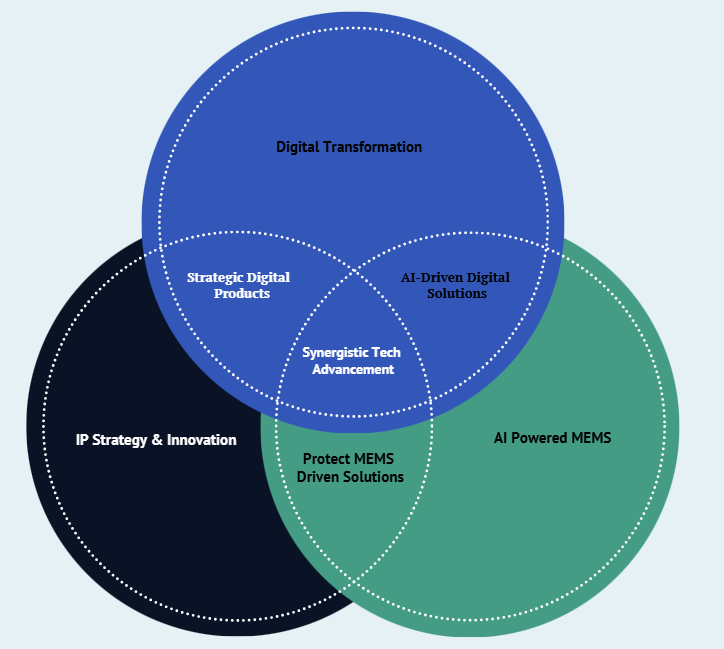
The convergence of digital transformation, intellectual property (IP) strategy, and TinyML-based MEMS sensors represents the fusion of advanced sensing technologies, edge intelligence, and strategic innovation management. This intersection enables organizations to capture real-world data at micro-scale, process it locally with machine learning, and use the resulting insights to drive new digital business models—while protecting and monetizing the underlying innovations.
1. Digital Transformation Layer
Digital transformation focuses on reimagining business operations and value delivery through digital technologies. MEMS sensors (Micro-Electro-Mechanical Systems) embedded with TinyML—machine learning models optimized for low-power devices—serve as critical enablers in this shift.
They:
- Bring intelligence to the edge, reducing latency and cloud dependence.
- Enable smart assets, predictive maintenance, and real-time decision-making.
- Generate high-value data streams that fuel AI-driven analytics, automation, and digital twins.
2. TinyML and MEMS Synergy
The integration of TinyML into MEMS sensors creates smart, autonomous microsystems capable of:
- Detecting complex physical phenomena (pressure, vibration, sound, motion)
- Running ML inference locally to classify anomalies or predict trends
- Operating under severe energy and space constraints
This enables embedded intelligence for IoT applications such as:
- Industrial process monitoring
- Healthcare wearables
- Environmental sensing
- Smart manufacturing and logistics
3. Intellectual Property (IP) Strategy Layer
At the innovation frontier, these technologies generate novel IP assets across multiple domains:
- MEMS Design Patents: Unique architectures, fabrication methods, and integration techniques.
- Algorithm and Model IP: Custom TinyML architectures optimized for edge inference.
- Data-driven IP: Proprietary datasets and model-training pipelines derived from sensor data.
- System-level IP: End-to-end frameworks integrating MEMS, firmware, cloud connectivity, and analytics.
A well-crafted IP strategy ensures that:
- Core technological differentiators are protected early (patent filings, trade secrets).
- Licensing, partnerships, and standardization efforts are aligned with growth goals.
- Innovation roadmaps balance open innovation with competitive advantage preservation.
4. Strategic Impact
When aligned, these three elements form a virtuous innovation loop:
- Digital transformation defines the business and operational goals.
- TinyML-based MEMS provide the enabling data intelligence at the physical layer.
- IP strategy ensures sustainability, defensibility, and monetization of innovations.
Together, they create digitally intelligent ecosystems that sense, learn, and adapt—turning physical interactions into strategic digital assets.